
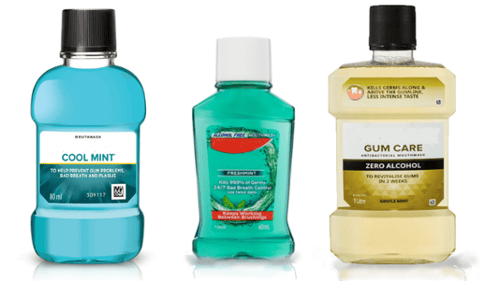
Part 1: Commonly available mouthrinses
There are different types of mouthwashes and they have different benefits depending on the active ingredient.
However, all mouthwashes, however beneficial, are only useful as an adjunct to brushing and flossing. Mouthwash alone is not enough to prevent decay and gum disease. This is because the bacteria that cause decay and gum disease can form a thick, sticky coating called 'plaque'. Mouthwash cannot penetrate completely through the plaque and kill all the bacteria. Plaque has to be scrubber off mechanically from the teeth surfaces by brushing and flossing.
This article looks at the more commonly available mouthwashes and their active ingredients
Chlorhexidine gluconate mouthwashes (CHX) e.g. Savacol, Colgate Perio-guard
Chlorhexidine gluconate is a substance that kills bacteria. It has been found the most effective in killing bacteria that cause gum disease and leads to large reductions in levels of plaque when used daily in conjunction with brushing and flossing. Hence, it is recommended for patients who have been diagnosed and are getting treatment for gum disease for short term use to help with improvement in gum health during the early phases of treatment.
CHX has also been shown to assist wound healing after dental surgery and for mouth ulcers. It is however best to seek advice from your health professional if you have undergone a procedure before using a CHX mouthwash post-operatively.
CHX is not recommended for long-term use (more than 6 months) as it increases the severity of stain adhesion on teeth surfaces and can affect taste sensation.
Essential oils e.g. Listerine
These include eucalyptol, menthol, thymol which occur naturally In plants (eucalyptus, mint and thyme). Research has shown that use of such mouthwashes in conjunction with mechanical plaque removal (brushing and flossing) leads to lower plaque and inflammation levels compared to brushing and flossing alone. Therefore, they are helpful when brushing and flossing is inadequate due to poor technique or lack of manual dexterity (e.g patients with arthritis or other restrictions in hand/arm mobility)
Cetylpyridium chloride e.g. Colgate Total mouthrinses
Cetylpyridium chloride (CPC) has been shown to be effective in reducing plaque levels associated with gum inflammation when used in conjunction with brushing and flossing. Similary to essential oils containing mouthwashes, CPC mouthwashes can be a helpful adjunct on top of brushing and flossing to control gum disease.
Hydrogen peroxide e.g Colgate Peroxyl
Hydrogen peroxide is a whitening agent used for teeth whitening. However, in mouthrinses, the low concentration of 1.5% is not sufficient for effective teeth whitening. Higher levels of peroxide could result in tissue irritation.
Peroxide mouthrinses have been shown to be slightly effective in reducing plaque and gum inflammation when using as an adjunct. However, they are less effective than chlorhexidine mouthrinses.
Fluoride e.g Colgate Neutrafluor
The fluoride used in some toothpastes and mouthrinses comes from sodium fluoride and binds to the enamel of teeth in a way that reduces its solubility to acids. Essentially, the fluoride makes tooth enamel harder and less prone to acid attack and decay.
Research has shown that regular use of fluoride containing mouthrinses can help prevent early decay lesions from progressing further. This is important as early lesions that progress to full-blown decay means that the tooth will require a filling.
While using a fluoride containing toothpaste is usually sufficient, those who have a diet high in sugar and have a high risk of decay, could reduce their need for fillings by using an additional fluoride mouthrinse twice daily.
Fluoride mouthrinses available over the counter contain 200- 1000 PPM (parts per million) of fluoride and can be used daily
Fluoride mouthrinses with higher levels (more than 1000 PPM) of fluoride should only be used if prescribed by your dentist.
In conclusion
The use of mouthrinses can be useful to improve oral health especially in cases of diagnosed gum disease or high decay risk. However, if toothbrushing and flossing techniques are adequate, mouthwashes are not mandatory. Furthermore, the environmental impact of using a mouthwash should be considered, as the manufacturing of the product and disposal of the empty containers do have a carbon footprint.
It is also not recommended to use alcohol containining mouthrinses over a long period of time (more than 6 months) as they may increase risks of oral cancers.
More importantly, ensure you have regular professional checks and cleans at your dentist and do not hesitate to seek their advice if you wish to incorporate a mouthwash in your daily routine. At the Melbourne Smile Clinic in Northcote, a dental check-up involves a thorough assessment for decay, gum disease and changes in the mouth that could indicate cancer risk. For appointments, book online, contact us here or call us on 90784471.
In Part 2, we will look at alternative mouthwashes and their efficacy.
References
1. Effectiveness of Mouthwashes in Managing Oral Diseases and Conditions: Do They Have a Role?
Colman McGrath, Janet Clarkson, Ann-Marie Glenny, Laurence J.Walsh, Fang Hua
International dental journal 73 ( 2023) s69 − s73
2. A randomised clinical evaluation of a fluoride mouthrinse and dentifrice in an in situ caries model.
Parkinson C.R., Hara A.T., Nehme M., et al
Journal of dentistry volume 70 pages 59-66 March 2018

Located in Melbourne Inner North, The Melbourne Smile Clinic is your dentist for Northcote, Thornbury, Fairfield, Westgarth, Clifton Hill, Preston and surrounding suburbs.
For more information or for an appointment, contact us on 9078 4471 or send us a message here